
NEWS
Here’s a comprehensive Diamond Lapping Film FAQ that covers the most common questions in labs, industry, and precision polishing:
Diamond Lapping Film FAQ
1. What is Diamond Lapping Film?
Diamond lapping film is a precision abrasive tool consisting of diamond particles embedded on a flexible backing, usually mylar. It is used for high-precision polishing, material removal, and surface finishing on hard materials like metals, ceramics, glass, and semiconductors.
2. What are the common grit sizes available?
Diamond lapping films come in a wide range of grits, from coarse to ultra-fine:
Coarse: 80 µm, 60 µm, 45 µm
Medium: 30 µm, 15 µm, 9 µm
Fine: 6 µm, 3 µm, 1 µm
Ultra-fine / Optical: 0.5 µm, 0.1 µm
The choice of grit depends on the material hardness and the desired surface finish.
3. What materials can be polished with diamond lapping film?
Diamond lapping film is highly versatile and can polish:
Metals: Steel, stainless steel, tungsten, alloys
Ceramics: Alumina, zirconia, silicon carbide
Semiconductors: Silicon, GaAs, sapphire
Optics: Glass, lenses, mirrors
Composites and micro-devices
4. What types of backing are available?
Standard mylar film: Flexible, durable, ideal for precision polishing
PSA-backed (Peel & Stick): Easy to mount on plates or holders
Sheets and discs: Available in sheets (8.5x11", 9x11") or discs (3", 6", 8")
Custom sizes: For specialized industrial applications
5. How should diamond lapping film be used?
Start with coarse grits for material removal.
Progressively move to finer grits for polishing.
Use water or oil as a lubricant to reduce heat and debris.
Keep the film clean to maintain uniform results.
Mount on a flat plate for planar surfaces or flexible holders for curved surfaces.
6. Can diamond lapping film be reused?
Yes, it can be reused if cleaned properly and not damaged. Thicker and PSA-backed films tend to last 5–10 times longer than thinner films.
7. What is the difference between dry and wet use?
Dry use: Suitable for quick polishing but may generate heat and debris
Wet use (water or oil): Reduces friction, improves surface finish, and prolongs film life
Recommendation: Use water for most applications to maintain optimal performance
8. What is the typical lifespan of a diamond lapping film?
The lifespan depends on grit size, material, and usage:
Coarse grits (80–30 µm): shorter lifespan due to heavy material removal
Fine and ultra-fine grits (6–0.1 µm): longer lifespan, especially when used with lubricant
PSA-backed or thick films: last 5–10 times longer than thin films
9. How to choose the right diamond lapping film?
Material hardness: Harder materials require diamond, softer materials may use aluminum oxide
Surface finish required: Coarse for shaping, fine/ultra-fine for optical/mirror finish
Shape and size of sample: Flat sheets for flat samples, discs for polishing tools or specific holders
10. Typical applications
Semiconductors: Wafer planarization, TEM/FIB sample prep
Optics: Lens and mirror polishing, glass finishing
Metallurgy: Hard metal and ceramic polishing, microsection prep
Medical / microdevices: Surgical tools, implants, precision components
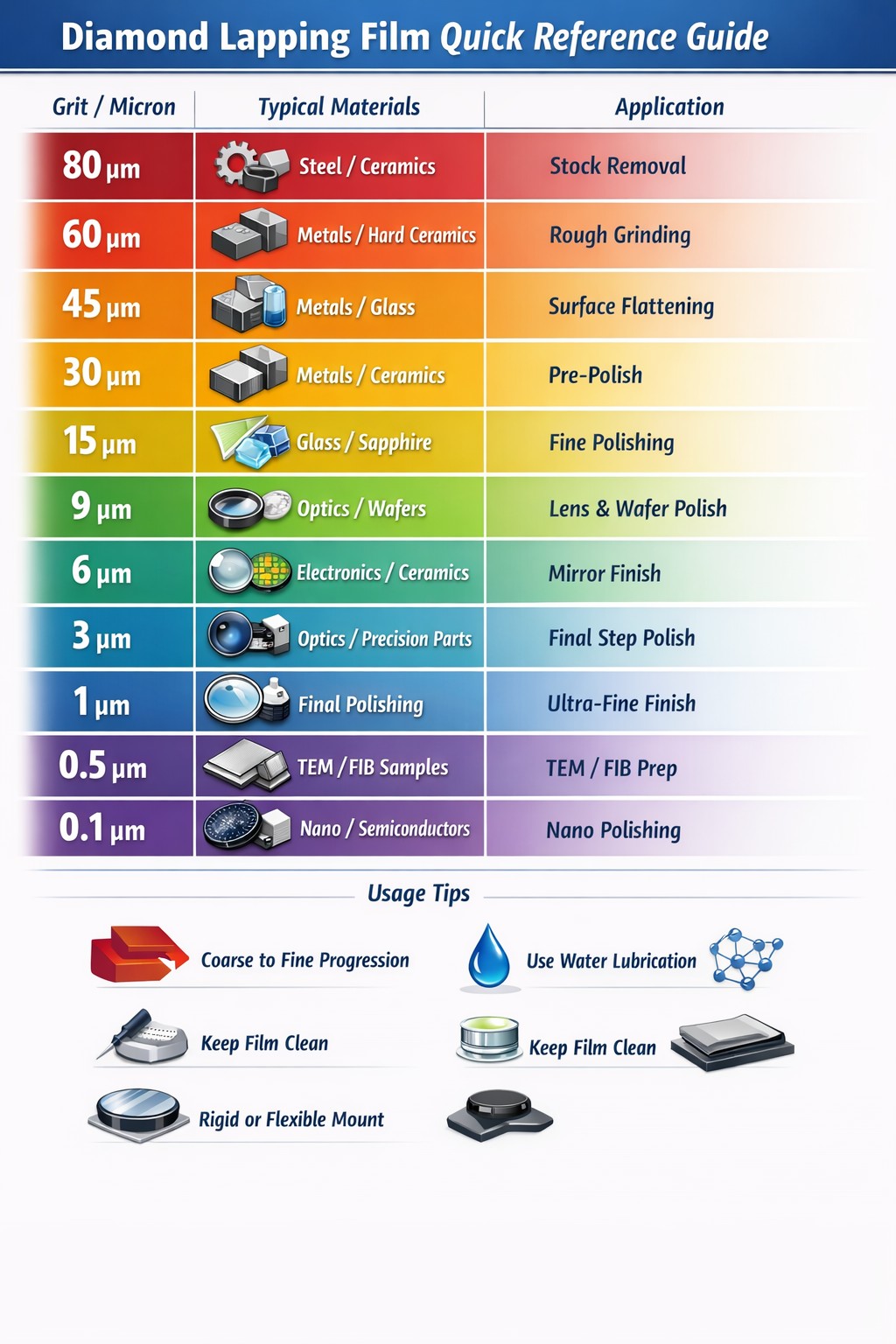
Diamond Lapping Film Quick Reference Guide
Usage Tips
Progressive Polishing: Always move from coarse → fine → ultra-fine for best results.
Lubrication: Use water for most materials to reduce friction and debris.
Cleaning: Keep the film clean to avoid scratching and maintain uniform results.
Mounting: Use a rigid plate for flat surfaces; flexible holders for curves.
Reusability: PSA-backed or thicker films last 5–10× longer than thin films.
This guide combines grit, material, and application in one glance, perfect for labs, workshops, or industrial floors.
Awesome! Share to:
Related Posts
- ◉ What technical support should I expect from a lapping film vendor?
- ◉ How to maintain batch-to-batch consistency in connector polishing?
- ◉ Is dry polishing better than wet for MTP connector finishing?
- ◉ What waste disposal requirements apply to polishing slurry in 2026?
- ◉ How to scale a polishing process from prototype to mass production?
Get in Touch
*We respect your confidentiality and all information are protected.