
NEWS
Here’s a clear, technical, long-form guide suitable for semiconductor labs, materials science, failure analysis, and precision polishing documentation. It’s written in a neutral, authoritative tone and can be used as a technical article, application note, or product page.
Diamond Lapping Film Grit Progression Guide
30, 15, 12, 9, 6, 3, 1 & 0.5 Micron Diamond Lapping Film Sheets
(Flat Lay on White Background – Close-Up Reference)
Overview
Diamond Lapping Film is a precision abrasive medium engineered for controlled material removal in advanced sample preparation and microfabrication processes. Each film sheet consists of precision-graded diamond particles, uniformly resin-bonded to a flat Mylar (PET) backing, delivering exceptional flatness, predictable cutting rates, and consistent surface finishes across a wide range of materials.
When arranged in a flat lay on a white background at close-up, these films visually demonstrate their defining characteristics: uniform abrasive distribution, smooth backing consistency, and micron-specific identification—critical for repeatable, stepwise polishing workflows.
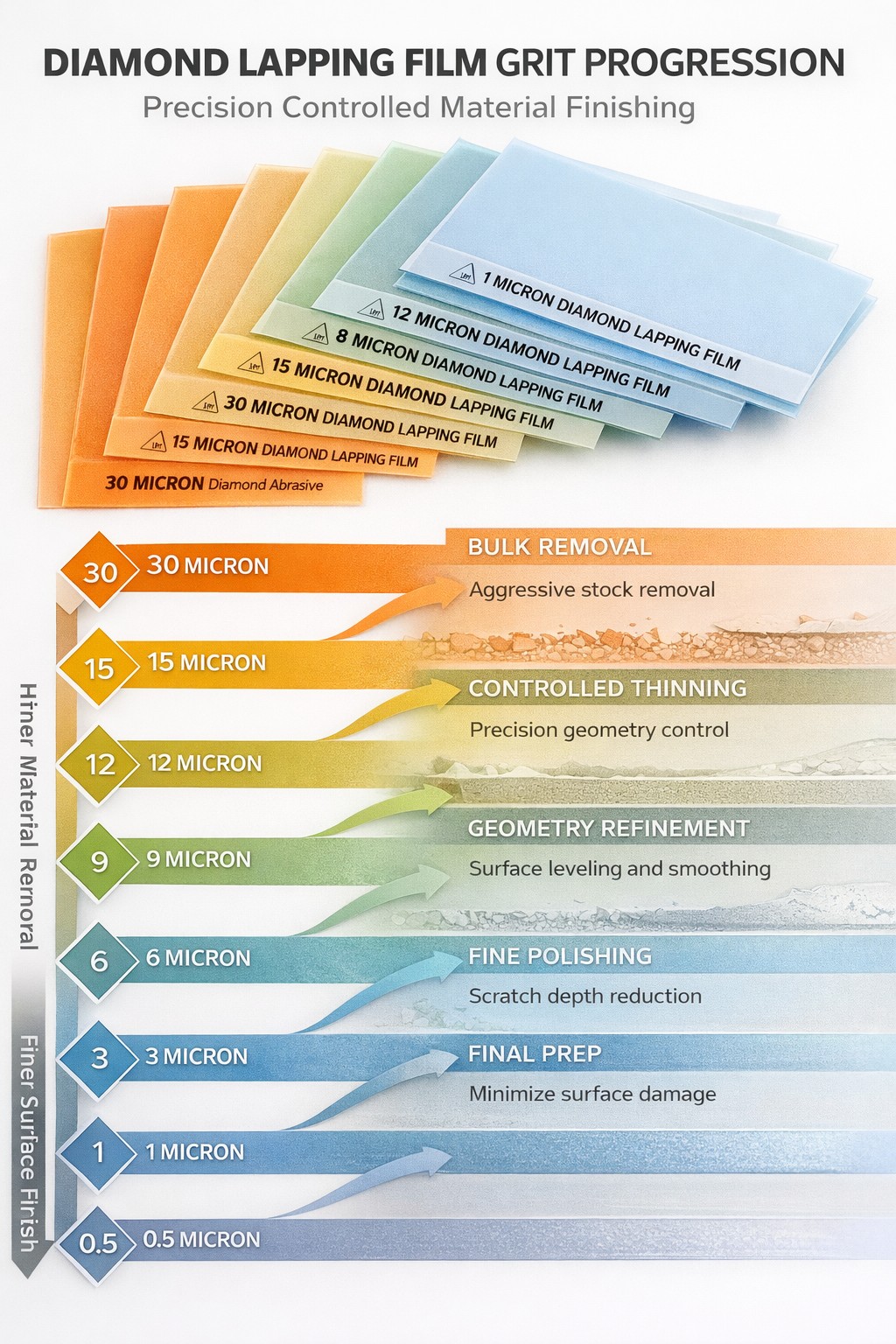
Construction and Material Science
Abrasive System
Abrasive type: Monocrystalline diamond
Grit range: 30 µm → 0.5 µm
Particle grading: Tight micron tolerances to ensure uniform scratch depth
Bonding & Backing
Bond: Resin-bonded abrasive layer for controlled exposure and particle retention
Backing: High-uniformity Mylar (PET) film
Thickness stability: Maintains coplanarity under wet polishing conditions
This construction enables uniform removal across heterogeneous materials, even when significant differences in hardness or modulus are present within the same sample.
Key Performance Characteristics
Excellent edge retention
Minimizes edge roll-off and rounding during thinning and cross-sectioning.Coplanarity preservation
Maintains flatness across multilayer or composite samples.Predictable material removal
Each grit delivers a controlled, repeatable removal rate.Low subsurface damage
Progressive grit sequencing reduces mechanical stress and microcracking.Clean, slurry-free operation
Ideal for laboratory and cleanroom environments.
Grit-by-Grit Technical Function Guide
30 Micron Diamond Lapping Film
Function: Aggressive stock removal
Primary Use:
Rapid thickness reduction
Initial backside material removal
Rough planarization of hard substrates
Used at the earliest stage where geometry correction and bulk removal are required.
15 Micron Diamond Lapping Film
Function: Intermediate bulk removal
Primary Use:
Transition from coarse grinding to controlled lapping
Flattening warped or uneven samples
Reduces deep scratches left by 30 µm while maintaining efficient removal.
12 Micron Diamond Lapping Film
Function: Controlled coarse lapping
Primary Use:
Precision thinning
Surface leveling prior to fine geometry control
Often selected when finer control than 15 µm is required, especially for brittle materials.
9 Micron Diamond Lapping Film
Function: Geometry refinement
Primary Use:
Unencapsulated cross-sectioning
Backside polishing before fine thinning
This grit marks the transition from bulk shaping to precision surface control.
6 Micron Diamond Lapping Film
Function: Fine lapping
Primary Use:
Scratch depth reduction
Preparation for TEM wedge or plan-view processes
Critical for minimizing subsurface damage before ultra-fine polishing steps.
3 Micron Diamond Lapping Film
Function: Pre-finish polishing
Primary Use:
Final geometry definition
Surface smoothing prior to fine thinning
Frequently used before FIB preparation to reduce ion milling time.
1 Micron Diamond Lapping Film
Function: Fine polishing
Primary Use:
TEM wedge and plan-view polishing
Backside thinning with tight thickness control
Delivers smooth, flat surfaces while preserving edges and interfaces.
0.5 Micron Diamond Lapping Film
Function: Ultra-fine polishing
Primary Use:
Final surface preparation before FIB
Minimizing surface damage and roughness
Often the last mechanical step before ion beam or chemical-mechanical finishing.
Typical Application Workflows
Unencapsulated Cross-Sectioning
Progressive lapping prevents layer delamination
Maintains sharp material interfaces
Supports accurate failure analysis
TEM Wedge & Plan-View Polishing
Produces thin, uniform electron-transparent regions
Minimizes curtaining and polishing artifacts
Backside Polishing
Enables precise wafer thinning
Preserves planarity for subsequent processing
FIB Sample Thinning (Pre-FIB)
Reduces FIB milling time
Improves surface quality and imaging stability
Enhances final analytical accuracy
Recommended Grit Progression Example
Skipping grit sizes is not recommended, as it increases subsurface damage and polishing time.
Best Practice Guidelines
Mount films on glass, ceramic, or precision metal plates
Use DI water or approved lubricant
Apply low, uniform pressure
Clean sample and surface between grit changes
Replace film once abrasive efficiency declines
Conclusion
30 to 0.5 Micron Diamond Lapping Film sheets form a complete, precision-controlled polishing system for advanced materials preparation. Their ability to deliver consistent edge retention, coplanarity, and predictable removal across varying material hardness makes them indispensable for semiconductor analysis, microscopy, and microfabrication workflows.
Awesome! Share to:
Related Posts
- ◉ What technical support should I expect from a lapping film vendor?
- ◉ How to maintain batch-to-batch consistency in connector polishing?
- ◉ Is dry polishing better than wet for MTP connector finishing?
- ◉ What waste disposal requirements apply to polishing slurry in 2026?
- ◉ How to scale a polishing process from prototype to mass production?
Get in Touch
*We respect your confidentiality and all information are protected.