
PRODUCTS
‹

›
‹
›





Product Details
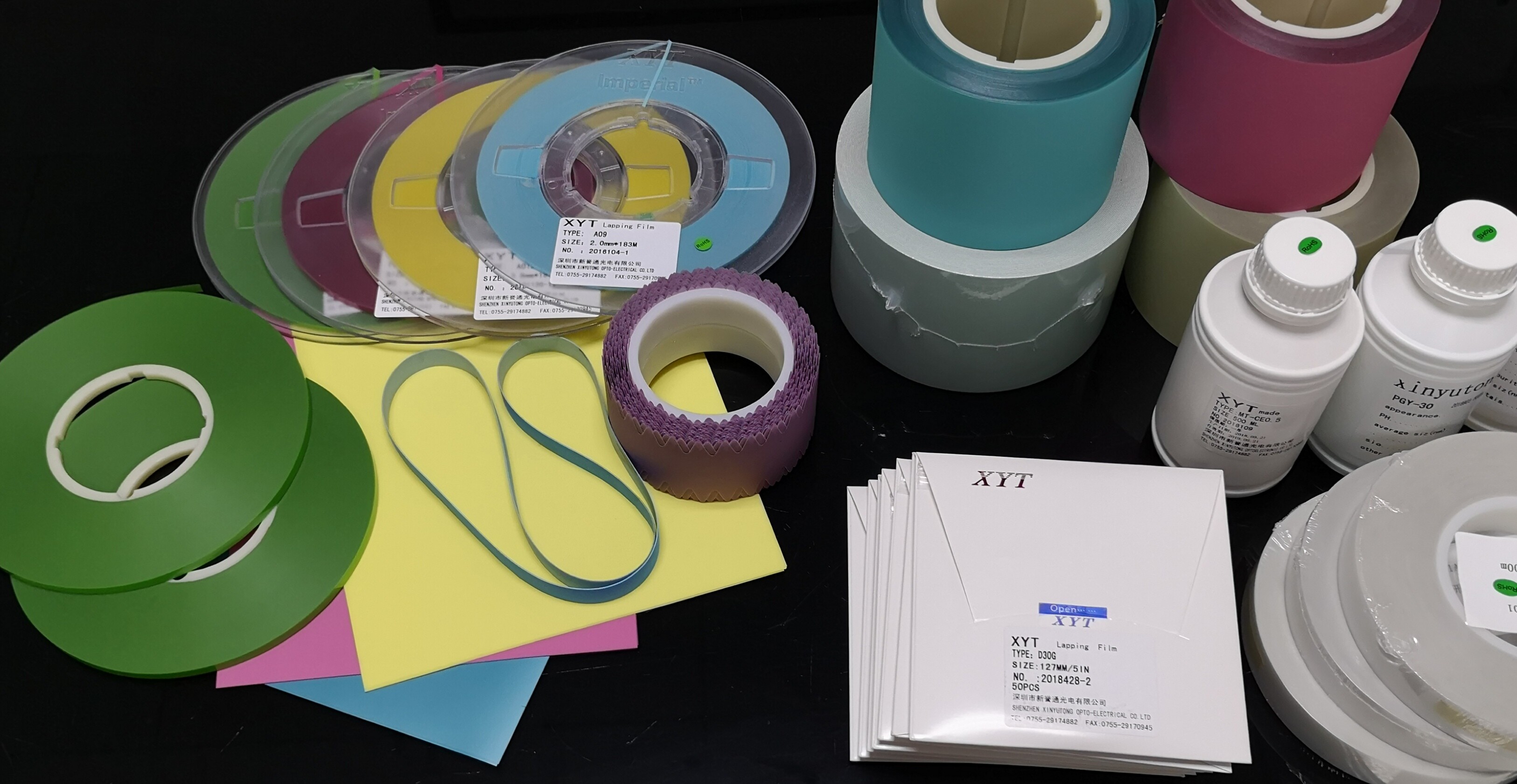
Common Abrasive Types in Lapping Films: A Complete Technical Guide
Selecting the right abrasive type is critical for achieving consistent surface finishes, long tool life, and efficient material removal. In precision applications such as lapping film polishing, fiber optic connector finishing, optical glass polishing, and “Scary Sharp” sharpening systems, the abrasive material determines cutting speed, surface quality, and cost efficiency.
This guide provides a detailed comparison of the most common abrasive types—Diamond, Aluminum Oxide, Silicon Carbide, and Cerium Oxide—along with key technical considerations when choosing lapping films.
Overview: Common Abrasive Types at a Glance
1. Diamond Abrasives – Ultimate Precision & Durability
Diamond lapping film uses micron-graded synthetic diamond particles electrostatically bonded to a polyester backing. As the hardest known abrasive material, diamond delivers unmatched performance on extremely hard substrates.
Best Applications
Tungsten carbide tools
Hardened steels & super-alloys
Ceramics & technical ceramics
Sapphire, gemstones, quartz
Fiber optic ferrule polishing (PC, UPC, APC)
Key Characteristics
Mohs hardness: 10 (highest possible)
Extremely aggressive cutting action
Maintains flatness and particle integrity
Long service life compared to all other abrasives
Produces uniform scratch patterns at ultra-fine micron levels
Advantages
Fast material removal with minimal pressure
Excellent repeatability for industrial polishing
Ideal for sub-micron and nanometer-level finishing
Considerations
Higher initial cost (offset by long lifespan)
Overkill for soft materials (can cause unnecessary wear)
SEO Tip: Diamond lapping film, diamond polishing film, micron diamond abrasive
2. Aluminum Oxide (AO) – Versatile & Cost-Effective
Aluminum Oxide lapping film is the most widely used abrasive due to its excellent balance between performance, durability, and cost. It is the preferred choice for many manual sharpening and maintenance systems.
Best Applications
Woodworking tools (chisels, plane irons)
Carbon steel & softer alloys
Maintenance polishing
“Scary Sharp” sharpening systems
Key Characteristics
Tough, blocky abrasive grains
Self-fracturing behavior for controlled cutting
Stable scratch pattern
Budget-friendly for high-volume use
Advantages
Excellent value for money
Easy to control and forgiving for hand polishing
Suitable for dry or wet use
Limitations
Slower cutting on very hard materials
Shorter lifespan compared to diamond
SEO Tip: Aluminum oxide lapping film, AO polishing film, Scary Sharp abrasive film
3. Silicon Carbide (SiC) – Fast Cutting & Sharp Grain Structure
Silicon Carbide lapping film is sharper and more brittle than Aluminum Oxide, allowing for faster initial material removal. It is commonly used where aggressive cutting is required before fine finishing stages.
Best Applications
Plastics & composites
Fiberglass & resins
Cast iron
Initial metal stock removal
Surface preparation before fine polishing
Key Characteristics
Sharper cutting edges than AO
More brittle grains that fracture quickly
Faster cutting but reduced durability
Advantages
Excellent for rapid stock removal
Works well on non-ferrous materials
Produces clean cutting action
Limitations
Shorter usable life
Not ideal for ultra-fine finishing
SEO Tip: Silicon carbide lapping film, SiC polishing film, aggressive abrasive film
4. Cerium Oxide – Optical-Grade Finishing for Glass
Cerium Oxide is unique among abrasives because it works through chemical-mechanical polishing (CMP) rather than purely mechanical abrasion. It reacts with glass surfaces to achieve extremely smooth, reflective finishes.
Best Applications
Optical glass
Camera lenses
Precision mirrors
CRT, LCD, and display glass
Final polishing after diamond or SiC steps
Key Characteristics
Produces near-mirror surface finishes
Minimal scratch formation
Typically used as slurry or fine film
Advantages
Superior clarity and reflectivity
Essential for optical-grade polishing
Removes micro-scratches effectively
Limitations
Very slow material removal
Not suitable for metals or hard ceramics
SEO Tip: Cerium oxide polishing film, optical glass polishing abrasive
Key Features to Consider When Choosing Lapping Films
1. Backing & Attachment Type
Lapping films are available in two main backing options:
PSA (Pressure Sensitive Adhesive)
Peel-and-stick application
Mounts directly onto glass plates, granite, or metal platens
Ensures flatness and consistency
Ideal for precision and production environments
Plain Back (Non-Adhesive)
Used with clips, vacuum platens, or spray adhesive
More flexible and reusable
Preferred for manual sharpening setups
2. Micron & Grit Size Guide for Lapping Films
Unlike conventional sandpaper, lapping films use micron grading, which provides tighter tolerances, more uniform scratch patterns, and repeatable surface finishes. Below is a comprehensive micron-to-grit reference chart, covering coarse stock removal through ultra-fine mirror polishing.
Complete Micron to Grit Size Comparison
Note: Grit equivalence is approximate. Micron-rated abrasives are more precise and consistent than traditional grit-based sandpapers.
Recommended Grit Progressions by Application
Tool Sharpening & “Scary Sharp” Systems
30 µm → 15 µm → 9 µm → 3 µm → 1 µm → 0.5 µm
Produces razor-sharp edges with controlled scratch patterns
Fiber Optic Connector Polishing (PC / UPC / APC)
30 µm (Optional) → 9 µm → 3 µm → 1 µm → 0.5 µm (Optional)→ 0.1 µm
Ensures low insertion loss and high return loss
Optical Glass & Lens Polishing
15 µm → 6 µm (Optional)→ 3 µm → 1 µm → Cerium Oxide final polish
Achieves high clarity and reflective surfaces
Metal & Precision Component Finishing
45 µm → 15 µm → 6 µm → 3 µm → 1 µm
Balances material removal with surface control
How Grit Size Affects Surface Finish
Coarse Microns (60–30 µm):
Fast cutting, deep scratches, rapid material removalMedium Microns (15–6 µm):
Scratch refinement, flatness control, transition stagesFine Microns (3–1 µm):
Surface smoothing, reduced Ra values, pre-polishUltra-Fine Microns (0.5–0.01 µm):
Mirror finishes, optical-grade surfaces, minimal defects
Why Micron-Rated Abrasives Are Superior for Precision Work
Tighter particle size distribution
Predictable cutting performance
Lower surface roughness (Ra)
Essential for high-end optics and fiber applications
Reduced risk of random deep scratches
Unlike sandpaper, lapping films are measured in microns, offering far greater precision.
Micron to Grit Approximation
1 micron ≈ 14,000–16,000 grit
0.5 micron ≈ 30,000 grit
0.1 micron ≈ 160,000–200,000 grit
Lower micron values = finer finish, lower surface roughness (Ra).
3. Wet vs. Dry Polishing
While lapping films can be used dry, wet polishing is strongly recommended.
Benefits of Wet Use
Flushes away swarf (metal debris)
Prevents loading and clogging
Reduces heat buildup
Extends abrasive life
Improves surface consistency
Common Lubricants:
Clean water (most common)
Light honing oil
Specialized polishing fluids
Conclusion: Choosing the Right Abrasive Matters
Each abrasive type serves a distinct purpose in precision finishing:
Diamond for extreme hardness and ultra-precision
Aluminum Oxide for versatility and cost efficiency
Silicon Carbide for fast, aggressive cutting
Cerium Oxide for optical-grade glass polishing
By combining the right abrasive type, micron size, backing option, and lubrication method, users can optimize performance, reduce costs, and achieve consistent, high-quality finishes.
Online Consultation
Related Suggestion
 MMC & MT Lapping Polishing Film: Premium Quality for High-Efficiency Polishing
 XYT Lapping Film for VSFF MMC16, MMC24, MMC32 Polishing
 Step-by-step SOP for MMC VSFF/TMT Polishing Solutions Guide
 Lapping Film Discs and Sheets for Laboratories
, MTCT®, and MT Ferrules Connectors") Lapping Film for PMT, Co‑Packaged Optics (CPO), MTCT®, and MT Ferrules Connectors
Lapping Film for PMT, Co‑Packaged Optics (CPO), MTCT®, and MT Ferrules Connectors XYT Precision Lapping Films and Polishing Consumables for MPO, MTP, and MMC Connectors
 High-Yield MPO/MTP/MMC Polishing Solution for Fiber Optic Patch Cord Ferrules
 Lapping Discs & Sheets – Diamond & Aluminum Oxide | Precision Polishing
 Explore Aluminum Oxide Lapping Film: 0.05 µm – 60 µm Grit Sizes | Discs & Sheets
 0.5 µm PSA Aluminum Oxide Lapping Film Discs & Sheets | Ultra-Fine Polishing
 30 µm PSA Aluminum Oxide Lapping Film Discs & Sheets | Coarse Polishing
 15 µm PSA Aluminum Oxide Lapping Film Discs & Sheets | Coarse Polishing
 12 µm PSA Aluminum Oxide Lapping Film Discs & Sheets | Coarse-to-Medium Pre-Polishing
 9 µm PSA Aluminum Oxide Lapping Film Discs & Sheets | Pre-Polishing
 6 µm PSA Aluminum Oxide Lapping Film Discs & Sheets | Pre-Polishing
 3 µm PSA Aluminum Oxide Lapping Film Discs & Sheets | Fine Polishing
 0.3 µm PSA Aluminum Oxide Lapping Film Discs & Sheets | Achieving Mirror-like Surfaces.


Get in Touch
*We respect your confidentiality and all information are protected.