
PRODUCTS
‹
›
‹
›





Product Details
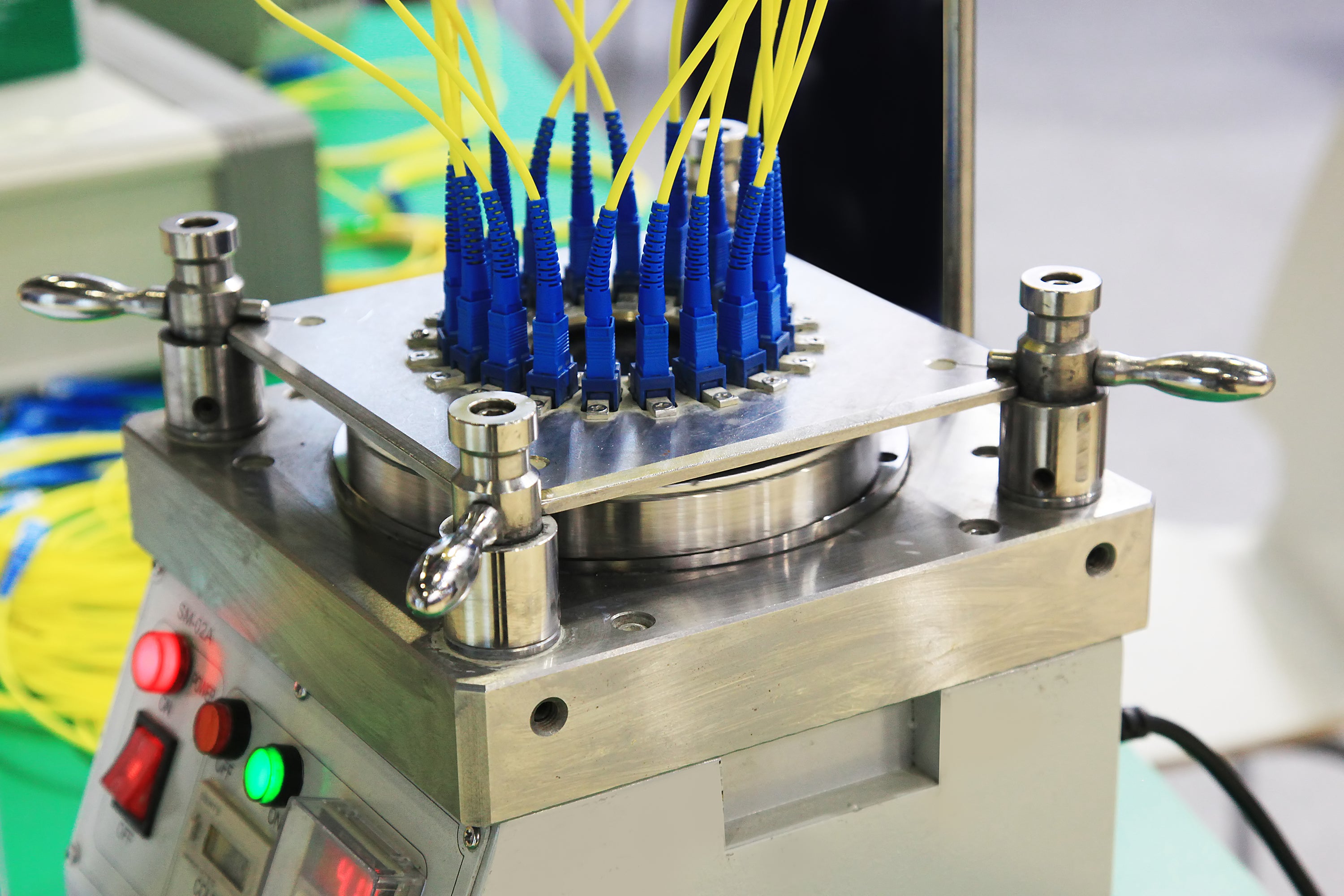
Fiber Optic Connector Polishing SOP
Connector Types: SC, LC, FC, ST, MU (UPC & APC)
Fiber Type: Single-Mode and Multi-Mode
Standards: IEC 61755 / Telcordia GR-326
Objective:
Achieve high-quality ferrule end-faces with:
Low Insertion Loss (IL ≤ 0.35 dB)
High Return Loss (RL ≥ 50 dB for UPC, ≥ 60 dB for APC)
Mirror-like surface finish (Ra ≤ 0.03 µm)
Uniform fiber height and correct apex geometry
1️⃣ Tools & Consumables
Note: Rubber pads are slightly compliant, reducing the risk of ferrule edge chipping and ensuring uniform polishing across the ferrule face.
2️⃣ Polishing Workflow
Step 1 – Epoxy Removal & Initial Flattening
Abrasive: SiC or coarse Diamond
Grit / Micron: 30 µm
Pad: Rubber Pad
Lubrication: DI Water
Goal: Remove epoxy flash, level ferrule end-face
Target Ra: 0.8–1.2 µm
Time: 30–60 sec
Inspection: Ferrule surface flush or slightly recessed; no epoxy beads.
Step 2 – Geometry Shaping & Apex Control
Abrasive: Diamond or fine SiC
Grit / Micron: 9–3 µm
Pad: Rubber Pad
Lubrication: DI Water
Goal: Establish correct ferrule radius, apex, and fiber height uniformity
Target Ra: 0.2–0.4 µm
Time: 30–60 sec
Inspection: Apex symmetrical, minimal scratches, fiber height uniform across ferrule.
Step 3 – Intermediate Smoothing
Abrasive: Diamond or Aluminum Oxide (Al₂O₃)
Grit / Micron: 1–0.5 µm
Pad: Rubber Pad
Lubrication: DI Water or light slurry
Goal: Remove residual scratches, prepare surface for final polish
Target Ra: 0.03–0.05 µm
Time: 30–60 sec
Step 4 – Final Optical Finish
Abrasive: SiO₂ or CeO₂ sub-micron
Grit / Micron: 0.05–0.5 µm
Pad: Rubber Pad
Lubrication: Slurry or DI Water
Goal: Achieve mirror finish for optical-grade performance
Target Ra: ≤0.03 µm
Time: 30–60 sec
Inspection: Surface glossy, defect-free; ready for optical testing.
3️⃣ APC Connector Special Notes
Final polish angle: 8°
Fiber protrusion: Ensure proper angle with polishing jig
Inspection: Check apex angle and RL ≥ 60 dB
4️⃣ Inspection Criteria
5️⃣ Troubleshooting Guide
6️⃣ Best Practices with Rubber Pad
Rubber pad reduces risk of over-polishing edges compared to rigid glass/ceramic pads.
Use light, consistent pressure; excessive force can deform pad and ferrule.
Always clean pads, films, and ferrules between steps.
Follow progressive micron sequence to prevent scratches.
APC connectors require an 8° angled final polish.
Record Ra, fiber height, IL, RL, and apex geometry for traceability.
7️⃣ Quick Reference Polishing Sequence (Rubber Pad)
✅ Outcome: Using a rubber pad ensures uniform ferrule polishing, reduced edge chipping, and optimized surface finish while maintaining compliance with IEC 61755 and Telcordia GR-326.
Online Consultation
Related Suggestion
 XYT Lapping Film for VSFF MMC16, MMC24, MMC32 Polishing
 Step-by-step SOP for MMC VSFF/TMT Polishing Solutions Guide
 Lapping Film Discs and Sheets for Laboratories
, MTCT®, and MT Ferrules Connectors") Lapping Film for PMT, Co‑Packaged Optics (CPO), MTCT®, and MT Ferrules Connectors
Lapping Film for PMT, Co‑Packaged Optics (CPO), MTCT®, and MT Ferrules Connectors XYT Precision Lapping Films and Polishing Consumables for MPO, MTP, and MMC Connectors
 High-Yield MPO/MTP/MMC Polishing Solution for Fiber Optic Patch Cord Ferrules
 Lapping Discs & Sheets – Diamond & Aluminum Oxide | Precision Polishing
 Explore Aluminum Oxide Lapping Film: 0.05 µm – 60 µm Grit Sizes | Discs & Sheets
 0.5 µm PSA Aluminum Oxide Lapping Film Discs & Sheets | Ultra-Fine Polishing
 30 µm PSA Aluminum Oxide Lapping Film Discs & Sheets | Coarse Polishing
 15 µm PSA Aluminum Oxide Lapping Film Discs & Sheets | Coarse Polishing
 12 µm PSA Aluminum Oxide Lapping Film Discs & Sheets | Coarse-to-Medium Pre-Polishing
 9 µm PSA Aluminum Oxide Lapping Film Discs & Sheets | Pre-Polishing
 6 µm PSA Aluminum Oxide Lapping Film Discs & Sheets | Pre-Polishing
 3 µm PSA Aluminum Oxide Lapping Film Discs & Sheets | Fine Polishing
 0.3 µm PSA Aluminum Oxide Lapping Film Discs & Sheets | Achieving Mirror-like Surfaces.
 1 µm PSA Aluminum Oxide Lapping Film Discs & Sheets | Ultra-Fine Polishing




Get in Touch
*We respect your confidentiality and all information are protected.