
NEWS
Choosing the right lapping film is one of the most important decisions in fiber optic connector polishing. For technical evaluators, the issue is not simply abrasive grade selection. The real question is how film design affects end-face geometry stability, insertion loss, return loss, throughput, consumable consistency, and process robustness across operators, machines, and connector types.
The core search intent behind this topic is practical evaluation guidance. Readers are usually comparing suppliers, abrasive systems, or polishing sequences, and they want a reliable framework for judging which lapping film will deliver repeatable fiber end-face results under production conditions. They are less interested in generic definitions and more interested in performance criteria, failure risks, and evidence-based selection methods.
Technical evaluators in this field typically care most about four things: whether the film can produce the target geometry, whether lot-to-lot consistency is strong enough for qualification, whether the film behaves predictably with their existing equipment and slurry-free processes, and whether total cost stays stable when scrap, rework, and downtime are included.
The most useful content, therefore, is not a broad overview of polishing theory. What helps most is a decision structure: how abrasive material influences cut behavior, how particle uniformity affects scratch control, how backing and adhesive stability influence repeatability, how process compatibility should be tested, and what qualification metrics should be used before approving a film for production.
This guide focuses on those decision points. It gives technical evaluators a practical method for selecting lapping film for stable fiber end-face results, with emphasis on measurable criteria, common failure modes, validation planning, and realistic trade-offs between polishing quality, throughput, and consumable life.
Why Lapping Film Selection Has a Direct Impact on Fiber End-Face Stability
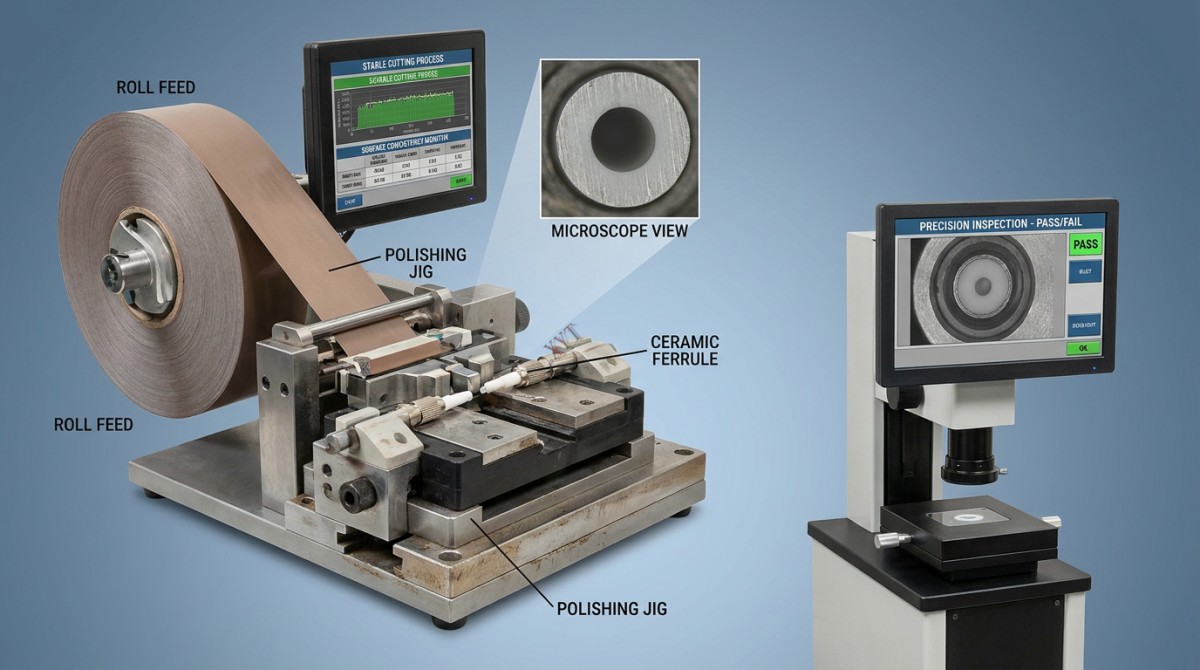
Stable fiber end-face results do not come from polishing machine settings alone. They depend on the interaction between pressure, pad condition, fixture alignment, polishing time, connector design, and the lapping film itself. Among these variables, film quality is often underestimated because it appears interchangeable on paper while behaving very differently in actual production.
For fiber optic connectors, “stable results” usually means maintaining consistent apex offset, radius of curvature, fiber height or undercut, scratch-free surfaces, and low optical loss across a full production lot. If the lapping film cuts too aggressively, too slowly, or unevenly, geometry drifts quickly and the process window narrows.
When a technical evaluator reviews polishing outcomes, it is important to distinguish between short-term success and long-term stability. Many films can produce acceptable samples during a brief trial. Fewer can maintain the same geometry and surface quality over multiple shifts, different operators, varying ambient conditions, and changing pad wear states.
The reason is simple. Lapping film is not just an abrasive layer. It is a controlled engineering surface. Abrasive species, particle sizing distribution, coating density, binder chemistry, backing flatness, backing tensile behavior, and dimensional stability all influence how material is removed from ferrule and fiber surfaces throughout the polishing cycle.
For fiber end-face polishing, small variations matter. A slight difference in abrasive protrusion can change the contact pattern. A backing with inconsistent stiffness can alter pressure transfer. A film with nonuniform abrasive distribution can introduce random scratch behavior. These effects are often invisible until process capability falls or optical performance starts drifting.
This is why evaluator-level selection should focus less on catalog claims and more on whether the lapping film supports a robust polishing system. A good film is not only capable of achieving a good end-face. It does so predictably, across time, at the expected throughput, within a manageable process window.
Understanding the Real Search Intent: What Technical Evaluators Need to Decide
When technical evaluators search for a lapping film selection guide, they are rarely looking for basic educational content alone. Most are already familiar with connector polishing stages and know that films are available in diamond, silicon dioxide, aluminum oxide, cerium oxide, and other abrasive systems. Their challenge is deciding what should be qualified and why.
In practice, the search intent usually falls into one of several scenarios. The evaluator may be developing a new polishing process for a connector family. They may be replacing an incumbent film due to quality drift or supply risk. They may be localizing procurement. Or they may be trying to improve yield, reduce cycle time, or eliminate persistent scratch defects.
In all of those cases, the key need is a technical decision framework. The evaluator wants to know which lapping film characteristics correlate most strongly with end-face outcomes, what test methods reveal risk early, and how to compare options fairly without being misled by isolated trial results or incomplete supplier data.
That is why this article gives priority to practical judging criteria instead of generic descriptions. For a technical evaluator, useful guidance answers questions such as: Which abrasive material is best for a specific polishing stage? How important is particle size tolerance? What backing properties most affect geometry control? How should one assess film life? What qualification data should a supplier be able to provide?
Another part of the search intent involves risk reduction. Technical evaluators are often gatekeepers for quality, throughput, and line stability. Approving the wrong film can trigger hidden downstream costs, including ferrule geometry failures, connector scrap, machine contamination, increased inspection load, customer returns, or production delays during revalidation.
So the real value of a selection guide lies in helping readers make an approval decision with confidence. The most relevant content is content that supports process qualification, identifies hidden failure modes, and translates material properties into production outcomes. That is the perspective used throughout the sections below.
Start with the End-Face Requirements, Not the Film Catalog
A common mistake in polishing consumable evaluation is to begin with available film grades rather than the required end-face specification. Technical evaluators should reverse that sequence. Start from the connector performance target and process constraints, then determine what the film must do at each stage of polishing.
Different connector applications demand different balances between geometry, surface quality, and throughput. For example, single-fiber connectors, MT ferrules, angled physical contact designs, and specialty optical terminations each present different contact patterns, material removal demands, and sensitivity to defect formation. A film suitable for one process may be unsuitable for another.
The target end-face characteristics should be defined explicitly. These often include ferrule geometry tolerances, surface roughness expectations, allowable scratch criteria under the inspection method used, optical insertion loss and return loss goals, and acceptable process capability levels at both pilot and mass-production stages.
Once those outputs are clear, the film can be evaluated by function. In coarse stages, the evaluator may prioritize controlled stock removal and geometry shaping. In intermediate stages, the focus may shift toward damage reduction and shape refinement. In final stages, the primary requirement becomes defect-free finishing with highly stable optical results.
This output-first approach is important because the same abrasive size can behave differently depending on backing construction, binder characteristics, and coating uniformity. Two 15 micron diamond films, for example, may have the same nominal grade yet deliver different removal rates, scratch profiles, and wear behavior in real polishing sequences.
By beginning with end-face requirements, technical evaluators avoid overvaluing nominal specifications and instead assess films according to actual process contribution. That improves qualification accuracy and shortens the path to a stable, repeatable polishing recipe.
Which Lapping Film Properties Matter Most in Fiber Optic Polishing?
Not every listed product parameter has equal value during evaluation. For fiber optic polishing, several film properties consistently have the strongest relationship with end-face performance and process stability. These should be the core of any technical review, trial matrix, or supplier comparison exercise.
The first is abrasive material type. Diamond, aluminum oxide, silicon carbide, silicon dioxide, and cerium oxide each cut differently and interact differently with ferrule materials and fiber surfaces. Abrasive choice influences removal rate, scratch tendency, process aggressiveness, and final finish capability. Material selection must match the polishing stage, not just the desired speed.
The second is particle size distribution, not only nominal grit size. A tight distribution usually improves cut uniformity and reduces the probability of rogue scratches. Broad or unstable particle distribution can introduce inconsistent material removal and random defects that are difficult to trace, especially when the process otherwise appears under control.
The third is abrasive coating uniformity. Even if particle sizing is acceptable, uneven spatial distribution across the film can create localized differences in cutting behavior. On fiber optic connectors, these differences can show up as geometry variation, inconsistent scratch appearance, or unstable finish as the film wears through its usable life.
The fourth is backing quality. Polyester backing is common because it provides dimensional stability and handling convenience, but performance depends on thickness control, flatness, stiffness, tensile behavior, and resistance to deformation under pressure and heat. An unstable backing can compromise repeatability even when the abrasive itself is well engineered.
The fifth is binder and adhesion integrity. During polishing, the evaluator wants controlled release behavior, not premature shedding, glazing, or loading. If the abrasive layer breaks down unpredictably, the process window shrinks and defect rates increase. Binder behavior is particularly important when polishing parameters include high pressure, long cycle times, or warm operating conditions.
The sixth is compatibility with the rest of the process stack: polishing pads, pressure settings, machine kinematics, fixtures, cleaning sequence, connector type, and endpoint criteria. A film that performs well in isolation may still fail in practice if it interacts poorly with the chosen pad hardness or generates debris that is hard to remove before the next stage.
Finally, consistency across lots matters as much as peak performance. For production qualification, the best lapping film is often not the one that produces the single best sample result. It is the one that delivers acceptable and repeatable outcomes over time with predictable wear and minimal need for parameter correction.
How Abrasive Material Choice Affects End-Face Geometry and Optical Performance
Abrasive material is one of the first screening decisions because it determines the basic cutting mechanics of the film. However, selection should not be reduced to simple assumptions such as “diamond is better” or “oxide films are finer.” Each abrasive type has strengths depending on process stage, ferrule material, and end-face objectives.
Diamond lapping film is widely used in fiber optic polishing because of its hardness, cutting efficiency, and ability to support controlled material removal. It is especially valuable in stages where ferrule geometry must be established efficiently and where consistent stock removal is important for production throughput.
Because diamond cuts aggressively and predictably when engineered well, it is often selected for rough and intermediate polishing steps. In many processes, it helps technical teams shorten cycle time while preserving process control. That said, aggressive cutting also means that poor particle control or inappropriate step transition can increase scratch risk or overcut behavior.
Aluminum oxide can be useful in selected finishing contexts, depending on the connector design and process architecture. Silicon carbide may be considered where certain removal characteristics are desired, although it must be assessed carefully for scratch behavior and surface interaction. Silicon dioxide and cerium oxide are commonly associated with fine finishing stages where surface refinement is prioritized.
The key point for evaluators is that abrasive material cannot be selected independently from process sequence design. A coarse-stage film should remove material efficiently without causing damage that later stages cannot eliminate economically. A fine-stage film should improve surface quality without introducing geometry drift or excessive time burden.
Optical performance is influenced indirectly but strongly by these choices. Insertion loss and return loss are affected by geometry accuracy, fiber condition, and surface defect control. A film that leaves subvisible damage or inconsistent geometry may still pass a visual checkpoint yet undermine optical consistency in field conditions or tighter customer testing regimes.
Evaluators should therefore compare abrasive materials by stage-specific role: stock removal efficiency, geometry formation control, scratch behavior, transition cleanliness to subsequent steps, and sensitivity to process variation. This is more informative than comparing material names in isolation.
Why Particle Size Consistency Often Matters More Than Nominal Grit Rating
In many purchasing discussions, grit size becomes the dominant reference point because it is easy to specify. But for technical evaluators concerned with stable fiber end-face results, nominal grit size alone is insufficient. What matters more in many cases is how tightly the abrasive particle sizes are controlled and how consistently they are distributed across the film.
Two films labeled with the same micron grade can behave very differently. One may cut smoothly and predictably because the particle population is narrow and the coating is uniform. Another may contain a wider tail of oversized particles, leading to random scratch defects, irregular material removal, and reduced process confidence.
Oversized particles are especially problematic in fiber optic finishing because the polishing targets are small and tolerance windows are narrow. A single outlier particle can produce a defect that escapes immediate process assumptions. When scratch defects appear sporadically, teams may spend excessive time adjusting pressure, time, or pad conditions without addressing the actual consumable cause.
Consistency also affects film transition planning. If the previous stage leaves a deeper or less predictable damage pattern than expected, the next stage must work harder to recover the surface. This can lengthen cycle time, reduce final yield, or force the use of more conservative polishing parameters that lower throughput.
For this reason, supplier evaluation should include discussion of particle classification methods, quality control practices, and evidence of lot-to-lot micron consistency. Process trials should also be designed to expose outlier behavior rather than only average behavior. Looking only at mean results can hide rare but important defect generators.
Technical evaluators should ask a practical question: when this lapping film is used over many connectors, how often does it generate a surface condition that is harder than normal to recover in downstream steps? The answer is often more valuable than the nominal grit number printed on the package.
Backing Stability: The Hidden Driver of Repeatability
Backing construction is sometimes treated as a secondary detail, but in fiber polishing it is a major contributor to repeatability. The abrasive layer can only perform consistently if the backing provides stable support under the machine’s pressure and motion conditions. Even small changes in backing behavior can alter contact mechanics at the connector interface.
Polyester backing is common because it offers a practical balance of flexibility, dimensional stability, and durability. However, not all polyester backings perform the same way. Thickness uniformity, flatness, resistance to curling, tensile stability, and thermal behavior can all influence polishing consistency from one disc or sheet to the next.
If the backing is too compliant or inconsistent, pressure transfer may vary across the contact area. This can lead to uneven stock removal, geometry drift, or increased dependence on pad condition. If the backing is too stiff for the application, it may reduce the process’s ability to conform appropriately, which can create other geometry or scratch issues depending on connector type.
Backing stability also affects usability. Films that wrinkle, shift, curl, or mount inconsistently on the platen can create artificial variation that is then misread as machine or process instability. Technical evaluators should therefore include handling and installation behavior as part of film qualification, not as an afterthought for operators to manage later.
Another consideration is wear behavior over the useful life of the film. A backing that maintains flatness and support characteristics over repeated use helps preserve predictable removal rate. If backing properties drift as the film ages, the process may need frequent intervention or conservative change intervals, both of which raise operating cost.
In short, backing should be evaluated as a structural component of the polishing system. Stable backings make stable abrasive performance easier to realize, easier to transfer across lines, and easier to scale in production.
How to Evaluate Controlled Material Removal in Real Production Conditions
Controlled material removal is often listed as a product advantage, but evaluators need to define what that means operationally. In fiber optic polishing, it means not only that material is removed, but that removal is predictable in rate, uniform across the working surface, responsive to parameter changes, and stable over the film’s usable life.
A film with a very high initial cut rate is not automatically desirable. If the rate decays sharply after a short period, or if it varies significantly between lots, the process becomes harder to control. Likewise, if the film is too slow, operators may compensate with longer cycle times or higher pressure, which can introduce geometry drift or reduce line efficiency.
The best way to assess removal control is through structured trials that monitor both outcome and trend. Measure stock removal or geometry change at defined intervals over the life of the film, not just at one endpoint. Look for smooth, predictable behavior rather than a strong first few samples followed by instability.
It is also important to test across realistic production variables. Include multiple operators if manual handling is involved, multiple fixture positions if applicable, several pad conditions, and more than one lot of connectors or ferrules if available. Stable films tend to remain manageable across these variations, while marginal films require narrow conditions to succeed.
Pay attention to sensitivity. If a small change in polishing time causes a large shift in geometry, the film may cut too aggressively or too inconsistently for an efficient production window. Technical evaluators generally prefer films that offer enough removal efficiency without making the process hypersensitive to normal operational variation.
Controlled removal should also be judged in terms of downstream impact. If a film removes stock efficiently but leaves a damage pattern that requires extra finishing, then the apparent gain may disappear at the system level. The correct evaluation is total process behavior, not isolated removal speed.
Scratch Control and Surface Quality: What Separates a Good Trial from a Reliable Process
Many lapping films can produce visually acceptable parts during a controlled trial. The harder question is whether they can maintain low scratch incidence over sustained production. Surface quality is where technical evaluators often uncover the difference between a film that looks good in a supplier demonstration and one that supports a robust factory process.
Scratch defects can arise from several film-related causes: oversized abrasive particles, uneven abrasive coating, unstable binder release, contamination retention, debris loading, or interaction with pad and cleaning conditions. Because multiple causes can produce similar visual outcomes, evaluators should resist making quick assumptions based on microscope images alone.
Reliable scratch control starts with consumable consistency. A well-made lapping film produces a predictable scratch signature for its stage, making it easier for the next step to remove that signature completely. An inconsistent film produces variable damage depth, and variability is exactly what reduces confidence in final polishing performance.
Cleaning behavior matters too. Some films generate debris that is easier to flush or wipe away before the next stage, while others may contribute to carryover contamination if the process is not tightly managed. When evaluating films, inspect not only the polished surface but also the cleanliness burden they impose on the rest of the line.
For technical evaluators, the most useful tests include repeated sample runs, deliberate film-life extension trials, and defect mapping over time. A film that remains clean and stable only under ideal change intervals may not be the most economical option once realistic production discipline is considered.
Surface quality evaluation should also be aligned with final application risk. If the connector is used in demanding telecommunications, data center, defense, or industrial environments, tolerance for latent defects may be low. In such contexts, a lapping film with slightly slower throughput but stronger scratch control can be the better engineering choice.
Lot-to-Lot Consistency Is a Qualification Issue, Not a Purchasing Detail
One of the biggest gaps in consumable qualification is the tendency to validate one lot and assume all future lots will perform the same. For technical evaluators, that assumption can be dangerous. Lot-to-lot consistency is central to process capability and should be treated as a formal qualification criterion.
In fiber optic polishing, even subtle consumable variation can show up as geometry drift, changes in removal rate, altered finishing behavior, or increased scratch incidence. These effects may not be obvious during incoming inspection if the inspection is limited to label verification or basic visual checks.
To evaluate lot consistency properly, use more than one manufacturing lot during approval whenever possible. Compare removal behavior, end-face geometry, defect rates, and usable life under the same process conditions. If the supplier provides statistical quality data, review whether it reflects parameters relevant to polishing performance rather than only generic factory controls.
Lot consistency also relates to change management. Technical teams should ask whether raw materials, coating methods, particle classification methods, or backing sources are tightly controlled. If changes occur, how are they validated internally? Is there traceability from finished film back to critical process parameters? These questions matter because they influence future stability after approval.
For companies operating globally or across multiple production sites, consistency is even more important. A film that behaves differently from lot to lot can undermine process transfer, complicate troubleshooting, and increase the burden on engineering support teams. In contrast, strong consumable consistency makes standardization easier and lowers hidden operating costs.
Technical evaluators should therefore request sample plans and supporting quality information that reflect ongoing manufacturability, not just laboratory capability. The goal is not only to approve a good sample. It is to approve a supply base that can sustain stable fiber end-face results over time.
How Process Compatibility Should Be Tested Before Approving a Lapping Film
A lapping film cannot be judged fairly outside the context of the process in which it will run. Compatibility testing is essential because polishing results emerge from interactions between consumables, equipment, fixtures, and cleaning controls. A technically strong film may still underperform if the surrounding process conditions do not suit its design.
First, evaluate compatibility with the polishing machine. Machine motion profile, platen flatness, pressure control, and speed stability all influence how a film behaves. If approval testing is performed on equipment that differs significantly from production equipment, trial results may overstate or understate actual performance.
Second, test the film with the intended polishing pad or support surface. Pad hardness, resilience, wear state, and surface conditioning can all affect contact mechanics. Films that appear equivalent on one pad may behave differently on another, particularly in geometry-sensitive connector processes.
Third, confirm compatibility with fixture design and connector family. Single-fiber and multi-fiber connectors can respond differently to the same abrasive system. The ferrule material, contact area, and pressure distribution should all be reflected in the trial plan. Evaluators should avoid broad approval claims based on only one connector style unless that is the only intended use case.
Fourth, assess cleaning and contamination control requirements. Some films are more forgiving of standard cleaning routines, while others need tighter debris management between stages. If a film imposes more cleaning complexity than the line can realistically sustain, process stability may suffer despite good short-term polishing performance.
Fifth, test under realistic operator conditions. If film mounting, alignment, or replacement is sensitive, that sensitivity should be exposed during qualification. Production success depends on practical usability as much as intrinsic film quality. Evaluators should consider how easy the film is to integrate into standard work instructions without excessive training dependence.
Compatibility testing should end with a simple question: does this lapping film enlarge or shrink the practical process window on our line? Films that enlarge the window are generally safer, easier to scale, and more valuable over time.
Designing a Practical Qualification Plan for Technical Evaluation Teams
A well-designed qualification plan helps technical evaluators compare lapping film options objectively and avoid decisions based on isolated good samples. The best plans are structured, stage-specific, and linked to end-face and production targets from the start.
Begin by defining the use case clearly. Identify connector type, ferrule material, polishing machine model, pad type, process stage where the film will be used, target geometry metrics, optical acceptance criteria, and expected production throughput. Without this context, trial data will be difficult to interpret or compare.
Next, determine the key output metrics. These often include removal rate, geometry capability, scratch incidence, surface finish consistency, insertion loss, return loss, film usable life, and yield impact. Include both mean performance and variation, because production risk usually emerges from the tails rather than the average.
Then set the comparison method. Use the same machine, operator training level, cleaning steps, environmental conditions, and inspection criteria across suppliers whenever possible. If multiple variables change at once, results become ambiguous and the trial may not support a defensible approval decision.
Include short-term and extended-use testing. Short-term testing shows whether the film can hit target performance. Extended-use testing shows whether it can maintain that performance through its intended service interval. A film that starts strong and degrades unpredictably may still pass a basic trial if life testing is skipped.
Where possible, include more than one lot from each candidate supplier. This helps reveal whether good results are representative or accidental. For strategic approvals, it is also wise to keep retained samples and detailed trial records so future drift investigations can reference a documented baseline.
Finally, define decision thresholds before reviewing results. For example, specify acceptable removal variability, maximum scratch rate, minimum optical performance, and allowable consumable life spread. Predefined thresholds reduce bias and make the qualification process more transparent for engineering, quality, and procurement stakeholders.
What to Ask a Lapping Film Supplier During Technical Review
Supplier discussions are most productive when technical evaluators ask targeted questions tied to process outcomes. Instead of asking only for catalog sheets and price, ask how the film is made, controlled, and supported in production applications similar to yours. The answers often reveal more than sample performance alone.
Start with abrasive control. Ask what particle sizing methods are used, how oversized particles are minimized, and how coating uniformity is verified. If the supplier can explain these controls clearly, it suggests a deeper process understanding and greater likelihood of repeatable product quality.
Ask about backing control next. What backing material is used? How is thickness variation controlled? How is dimensional stability maintained during coating, slitting, storage, and shipment? Since backing behavior influences repeatability, this information is highly relevant for fiber optic polishing applications.
Then ask about lot traceability and change management. Can each film lot be traced to raw material and production records? How are process changes validated? Is customer notification available for significant changes? These questions help evaluators judge supply risk beyond initial sample success.
It is also useful to ask about recommended operating windows. What pressure, speed, pad, and change interval ranges has the supplier observed in similar applications? A strong supplier will avoid generic claims and instead discuss how film behavior can vary with the process environment.
Support capability matters as well. If geometry drift or scratch defects appear after approval, can the supplier help diagnose root causes? Do they have application engineers, lab resources, or comparative trial capability? Technical evaluators often need more than a product; they need a partner that can help stabilize and optimize the polishing process.
Finally, ask for evidence, not only assertions. Data on removal consistency, defect rates, life testing, and similar applications carries more value than broad marketing language. Supplier responsiveness and technical transparency are themselves meaningful evaluation signals.
Balancing Quality, Throughput, and Consumable Cost
Technical evaluators are often expected to support quality goals while also acknowledging production efficiency and cost pressures. In lapping film selection, the lowest unit price rarely reflects the lowest total cost. A more useful evaluation compares total process economics under realistic operating conditions.
For example, a cheaper film with wider removal variation may require more frequent parameter adjustment, earlier replacement, tighter operator control, or extra finishing time downstream. Those indirect costs can outweigh any savings on purchase price. Likewise, a film that raises scratch incidence slightly can increase inspection burden, rework, and scrap.
Throughput should be evaluated carefully. A faster-cutting film can improve line output if it maintains geometry and finish quality within a comfortable process window. But if higher removal speed makes the process overly sensitive, the resulting instability can reduce actual productivity once downtime and troubleshooting are included.
Consumable life is another area where simplistic comparisons can mislead. Longer life is beneficial only if the film’s performance remains stable over that extended interval. A film that technically lasts longer but needs frequent result monitoring or causes late-life defects may be less valuable than one with a shorter but more predictable service interval.
The most economically sound lapping film is usually the one that supports the best combination of yield, stable optical performance, manageable cycle time, low troubleshooting burden, and predictable replacement planning. Technical evaluators should present selection findings in those terms when communicating with cross-functional teams.
This broader cost perspective is especially important for organizations producing at scale or supplying quality-sensitive markets. Stable fiber end-face results protect customer confidence, reduce operational noise, and make production planning more reliable. Those advantages often justify a higher-performing consumable even if its unit price is not the lowest available.
Common Mistakes When Selecting Lapping Film for Fiber End-Face Applications
Several recurring mistakes can weaken lapping film selection and lead to avoidable process instability. Recognizing these mistakes early helps technical evaluators design stronger comparisons and make more reliable approval decisions.
The first mistake is evaluating only one trial condition. A film that performs well at a single pressure and time setting may still be too sensitive for production. Robust evaluation should test whether the film remains predictable across a practical operating range, not merely whether it can produce one acceptable result.
The second mistake is overemphasizing nominal grit size while underemphasizing particle consistency, coating uniformity, and backing stability. These hidden variables often explain why two similarly labeled films perform differently in actual connector polishing.
The third mistake is ignoring downstream effects. If a film improves one stage but complicates the next, the total process may get worse. Evaluators should examine stage-to-stage transitions, not just isolated step performance. A good polishing system is built on cumulative compatibility.
The fourth mistake is qualifying only one production lot. This creates false confidence and leaves the line exposed to future variation. Multi-lot assessment is one of the simplest ways to improve approval reliability, yet it is often skipped due to schedule pressure.
The fifth mistake is treating supplier support as nonessential. In high-precision polishing, consumable behavior can be subtle and process interactions can be complex. Suppliers with strong application knowledge often help shorten troubleshooting time and improve long-term stability after initial approval.
The sixth mistake is measuring only visible surface quality and not correlating it with geometry and optical data. A connector can look acceptable under a microscope yet still show unstable optical performance if geometry control or sub-surface effects are poor. Selection should therefore combine visual, dimensional, and functional outcomes.
How a 15 Micron Diamond Film Fits into a Polishing Strategy
In many fiber optic and precision finishing processes, a 15 micron diamond film occupies an important role in the shaping or intermediate stock-removal portion of the sequence. Its value lies in the ability to remove material in a controlled manner while maintaining a predictable damage pattern that later stages can refine efficiently.
For technical evaluators, the question is not whether a 15 micron grade is universally correct. The question is whether it fits the intended stage logic. If your process needs efficient ferrule shaping, stable geometry development, and repeatable transition into finer polishing steps, a well-engineered 15 micron diamond lapping film can be a strong candidate.
Backing durability is especially important at this grade because the film often sees meaningful contact pressure and must maintain stable support as material removal proceeds. A durable polyester backing with consistent abrasive distribution can help keep removal behavior predictable across repeated use.
One example relevant to this evaluation context is Diamond Lapping Film – 15 Micron Discs & Sheets | XYT Polishing Film. For applications such as fiber optics, electronics, metallurgy, and optics or ceramics, this type of film is positioned around precision surface finishing, controlled material removal, consistent surface quality, and long-lasting durability.
From a technical review perspective, the significance of such a product is not the claim itself but how those characteristics map onto your process objectives. If the abrasive layer, backing stability, and wear behavior support repeatable stock removal and clean stage transition, then the film may help improve both end-face consistency and line efficiency.
As always, evaluators should confirm fit through structured trials. Even a promising diamond film should be judged by actual geometry results, scratch behavior, life stability, and compatibility with your machine, pad, connectors, and inspection requirements.
Why Manufacturing Capability Behind the Film Matters
For precision polishing consumables, manufacturing capability is not a background detail. It directly affects product consistency, supply reliability, and long-term qualification stability. Technical evaluators should therefore look beyond individual samples and consider whether the supplier’s production system is capable of sustaining the required quality level.
In high-end abrasive manufacturing, coating precision, environmental control, inspection systems, slitting accuracy, and quality management all influence the finished film. Abrasive products used for fiber optics benefit from production environments that can reduce contamination risk and maintain tight control over coating uniformity and backing handling.
Suppliers with dedicated R&D resources and in-line quality controls are often better positioned to support application optimization and lot consistency. This matters when your process needs repeatable geometry and low defect rates over a long qualification horizon, not just a successful first sample run.
XYT, for example, positions itself as a high-tech enterprise focused on premium lapping film and polishing products, supported by precision coating lines, optical-grade Class-1000 cleanrooms, R&D capability, controlled slitting and storage systems, and rigorous quality management. For evaluators, such capability is relevant because it suggests a manufacturing base aimed at consistency rather than simple commodity output.
The company’s broader portfolio in diamond, aluminum oxide, silicon carbide, cerium oxide, silicon dioxide, polishing liquids, oils, pads, and precision equipment also indicates the ability to support one-stop surface finishing needs across industries including fiber optic communications. That can be useful when process optimization requires coordinated consumable changes rather than isolated product substitution.
Of course, facility scale and global reach do not replace technical validation. But they do matter in supplier screening, especially when you need stable supply, application support, and the confidence that future lots will resemble qualified lots in meaningful performance terms.
Building an Internal Evaluation Scorecard
One of the best ways to make lapping film selection more objective is to create an internal scorecard. This helps technical evaluators compare candidates consistently, align with quality and procurement teams, and document why one film was approved over another.
A practical scorecard usually combines performance, robustness, supply, and economic factors. Performance criteria can include removal consistency, geometry capability, scratch control, optical outcomes, and stage transition behavior. Robustness criteria can include sensitivity to pressure variation, operator handling, pad condition, and film-age effects.
Supply-related criteria may include lot traceability, manufacturing controls, global availability, lead-time stability, and technical support responsiveness. Economic criteria can include unit cost, usable life, yield impact, required change frequency, and downstream rework burden. Weighting should reflect the business importance of each factor.
The value of a scorecard is not mathematical precision alone. Its main value is forcing evaluators to consider the complete decision picture. A film that scores well on price but poorly on lot consistency may not be a wise choice for high-reliability fiber optic production. A film that scores well on quality but poorly on usability may create execution challenges on the shop floor.
Scorecards also improve organizational learning. If process drift appears months later, teams can revisit the original decision criteria and see whether any warning signs were underestimated. Over time, this strengthens the company’s consumable qualification process and reduces dependence on anecdotal judgment.
For technical evaluators working across multiple connector programs, a standardized scorecard also helps transfer best practices and speed up future approvals. The details may change by application, but the evaluation logic remains consistent.
Validation Metrics That Actually Predict Production Success
During qualification, it is easy to collect data that looks useful but does not predict real production performance. Technical evaluators should prioritize metrics that correlate strongly with ongoing line stability and customer-facing connector quality.
Removal rate is important, but removal rate alone is not enough. It should be paired with removal variability across time, across parts, and across film life. A stable moderate removal rate is often preferable to a fast but erratic one.
Geometry capability is essential because end-face shape influences physical contact and optical behavior. Evaluators should monitor not only average geometry values but also spread and drift under realistic production conditions. A film that centers near target but with wide variability may still create unacceptable field risk.
Scratch incidence should be tracked quantitatively where possible, not only descriptively. Count defect frequency, identify severity patterns, and note whether defects cluster late in film life or under specific handling conditions. This reveals whether the issue is fundamental or controllable.
Optical metrics such as insertion loss and return loss remain critical because they reflect functional output. However, they should be interpreted alongside process data rather than used as a late-only acceptance gate. If optical results fluctuate, process-side indicators can help determine whether the cause lies in film behavior, equipment, cleaning, or operator execution.
Film-life stability is another strong predictor of production success. Instead of assigning a life estimate based on one run, test to the intended replacement interval and beyond. Monitor when performance begins to shift, not just when outright failure occurs. This helps define practical change rules that protect quality without wasting consumables.
Finally, observe process burden: monitoring frequency required, cleaning effort, operator sensitivity, and troubleshooting demand. These are not secondary concerns. They strongly affect whether a lapping film will remain successful after engineering attention moves to other projects.
When to Reevaluate Your Current Lapping Film
Even a previously qualified lapping film should not remain unquestioned forever. Technical evaluators should trigger reevaluation when there are signs that process assumptions may no longer be valid. This is especially important in fiber optic polishing, where small shifts can have significant effects on end-face results and optical consistency.
One obvious trigger is a rise in scratch defects, geometry drift, insertion loss variability, or return loss complaints without a clear machine fault. If equipment and operator factors have been checked, consumable variation should move higher on the investigation list.
Another trigger is process transfer. If the same film is being introduced to a new machine platform, a new connector family, a new production site, or a new pad system, prior approval may not fully apply. Compatibility should be reconfirmed before assuming equivalent performance.
Supplier-related changes also matter. New lot behavior, packaging differences, storage issues, lead-time changes, or limited technical support can all justify reevaluation. If the supplier has modified raw materials or production processes, the film may need at least partial requalification depending on your risk framework.
Cost pressure can be another valid reason for review, but it should be handled carefully. If procurement seeks a lower-cost substitute, technical evaluation must look at total process impact, not purchase price alone. Stable fiber end-face results are too important to risk on incomplete comparisons.
Finally, reevaluate when performance goals rise. Higher-speed networks, tighter customer specifications, new reliability expectations, or improved internal capability targets may require a better or more specialized lapping film than the one that was sufficient in the past.
A Practical Selection Framework for Stable Fiber End-Face Results
To bring all of these points together, technical evaluators can use a straightforward selection framework. Begin with the required connector outputs: geometry, surface quality, optical metrics, and throughput needs. Then define the polishing stage role the film must play within the overall sequence.
Next, screen candidate films by abrasive material suitability, particle consistency, coating uniformity, backing stability, and expected compatibility with machine, pad, fixture, and cleaning conditions. Eliminate options that look attractive only on nominal grit or price but lack evidence of process consistency.
Then run a structured qualification plan that includes multiple conditions, realistic life testing, and preferably more than one lot. Measure not just whether the film can achieve target results, but whether it can do so repeatably and with a practical process window.
Review supplier capability alongside product performance. Strong manufacturing control, application support, and traceability increase the likelihood that approved performance can be sustained. In precision polishing, supplier quality systems are part of the technical risk equation.
After testing, compare candidates using a scorecard that reflects total process value: quality, robustness, usability, supply confidence, and economics. This helps prevent overreliance on any single result and supports cross-functional decision making.
Finally, define ongoing control rules after approval. These may include incoming lot verification, film-life limits, defect monitoring, and escalation triggers for reevaluation. A good lapping film selection process does not end at approval; it creates the basis for stable long-term production performance.
Conclusion
Selecting the right lapping film for fiber optic polishing is ultimately a process capability decision. Technical evaluators are not simply buying abrasive media. They are choosing a consumable that affects geometry stability, optical performance, yield, operator consistency, and total production efficiency.
The most important takeaway is that stable fiber end-face results come from evaluating the film as part of a complete polishing system. Abrasive material, particle size consistency, coating quality, backing stability, and process compatibility all matter, and lot-to-lot repeatability is just as important as the best result from a single trial.
For evaluators comparing options, the most reliable path is to start from end-face requirements, use structured multi-factor testing, demand useful supplier data, and judge success by long-term process behavior rather than isolated sample quality. That is how strong polishing processes are built and protected.
When this approach is followed, lapping film selection becomes much more than a consumable choice. It becomes a disciplined engineering decision that supports low loss, clean geometry, predictable output, and confidence in fiber optic connector quality at production scale.
Awesome! Share to:
Related Posts
- ◉ What technical support should I expect from a lapping film vendor?
- ◉ How to maintain batch-to-batch consistency in connector polishing?
- ◉ Is dry polishing better than wet for MTP connector finishing?
- ◉ What waste disposal requirements apply to polishing slurry in 2026?
- ◉ How to scale a polishing process from prototype to mass production?
Get in Touch
*We respect your confidentiality and all information are protected.