
NEWS
When does Aluminum Oxide Lapping Film actually cut polishing cost?
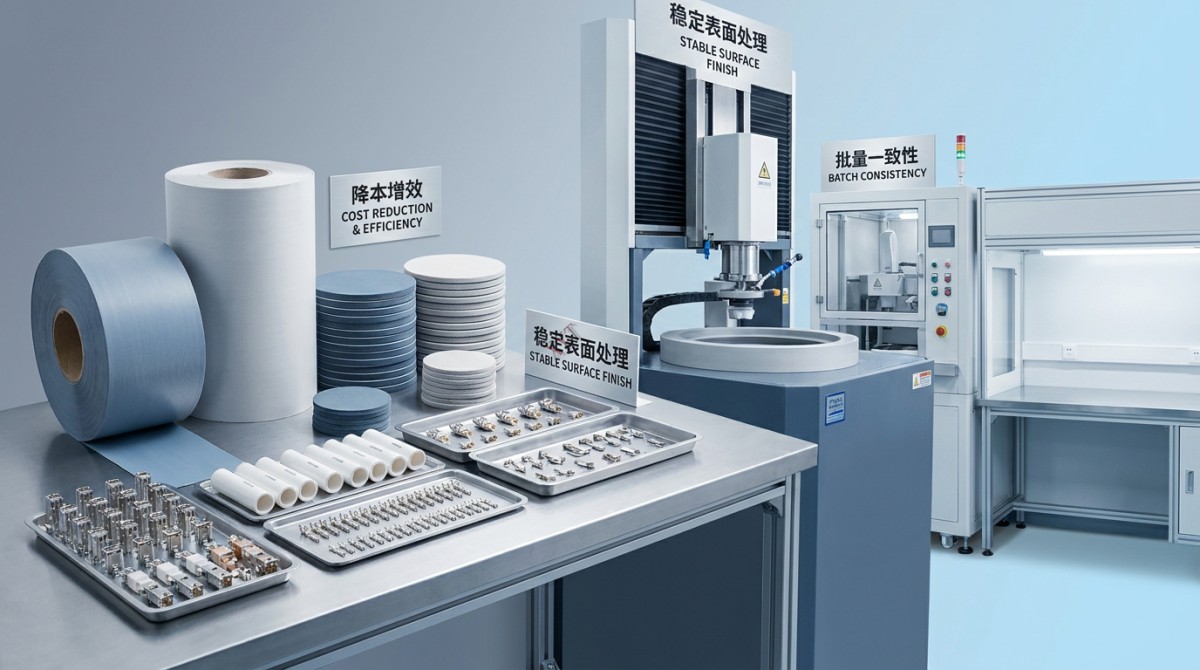
Cost reduction in polishing rarely comes from price alone.
The more useful question is whether Aluminum Oxide Lapping Film lowers total finishing cost across output, scrap, labor, downtime, and supply continuity.
In electrical equipment and precision component production, that question matters every day.
Contacts, ceramic parts, ferrules, connectors, relay components, sensor housings, and small metal parts all depend on repeatable surface control.
If the abrasive film is too aggressive, defects rise.
If it is too slow, machine time expands.
If quality varies by batch, the apparent unit price becomes meaningless.
That is why Aluminum Oxide Lapping Film remains widely used even when premium abrasives are available.
It offers a practical middle ground between removal rate, finish quality, and consumable expense.
Simple polishing jobs benefit from its value.
Many precision jobs do too, provided the grit, backing, pressure, and process window are matched correctly.
A common misunderstanding is that lower-cost abrasive media always produce lower-grade results.
That can be true in the wrong process.
It is not true by default.
For many electrical equipment applications, the target is not mirror optics.
The target is controlled flatness, acceptable roughness, dimensional stability, and repeatability through volume production.
In that operating zone, Aluminum Oxide Lapping Film often becomes the most economical choice.
This matters even more when production planners must balance cost pressure with stable supply.
A theoretically superior abrasive is not automatically the better business decision if lead times are long or qualification is difficult.
Reliable production depends on coating consistency, roll slitting accuracy, storage control, and inspection discipline.
These upstream factors strongly affect downstream polishing economics.
That is one reason experienced users examine suppliers, not just abrasive names.
XYT has built its position around that full-chain view.
Its work spans premium lapping film, grinding media, polishing liquids, pads, oils, and precision finishing equipment.
Its solutions support fiber optics, automotive parts, aerospace components, metal processing, micro motors, and consumer electronics.
That broad application base matters because polishing cost is never isolated from the rest of the line.
A film that behaves well in controlled clean production may fail in humid storage or automated high-throughput use.
A film that looks inexpensive on paper may create more dress cycles, fixture cleaning, or rework than expected.
So the real question is more specific.
When does Aluminum Oxide Lapping Film lower polishing cost without compromising quality or delivery reliability?
The answer depends on material type, finish target, process sequence, and supplier capability.
The sections below walk through those decisions in the way users usually search for them.
Not as a rigid checklist, but as the practical questions that shape actual polishing results.
Is Aluminum Oxide Lapping Film the right choice for electrical equipment parts, or only for basic polishing?
It is suitable for far more than basic polishing.
The key is understanding where its cutting behavior fits the material and finish requirement.
Aluminum oxide is a durable abrasive with balanced hardness and broad compatibility.
It performs well on many metals, ceramics, composites, and engineering materials used in electrical equipment and related assemblies.
For connector components, terminal surfaces, ferrule finishing steps, stamped precision parts, and micro motor components, it often gives stable stock removal.
That stability is one of its biggest economic advantages.
Some abrasives cut faster but leave a narrower processing window.
When pressure, speed, or lubrication vary slightly, results may drift more sharply.
Aluminum Oxide Lapping Film is often more forgiving in mixed operating conditions.
That matters on real production floors, where fixtures age, operators rotate, and different workpiece batches enter the same line.
In practice, this film tends to be a strong fit when the job requires:
- Predictable removal rather than maximum speed
- Fine finishing with controlled scratch depth
- Stable surface quality over many cycles
- Reasonable consumable cost in medium or high volume
- Easier qualification across multiple machines or sites
It is less ideal when the process demands extremely high removal on ultra-hard materials.
That is where diamond or silicon carbide may outperform it.
Even then, Aluminum Oxide Lapping Film may still be the smarter option in intermediate or finishing steps.
This is why line engineers often combine abrasives, rather than trying to force one material to solve everything.
Electrical equipment production frequently uses multi-stage polishing sequences.
A faster abrasive handles geometry correction or heavy stock removal.
Aluminum oxide then supports smoothing, refinement, or controlled final preparation.
That combined strategy lowers total cost better than overusing expensive media throughout every step.
A good example appears in fiber-related electrical components.
Certain geometry preparation steps benefit from specialized media designed for multi-fiber ferrules.
One reference point is Silicon Carbide Flocked Film for MT MPO MTP Ferrules Geometry Pre-Polishing – High-Precision Fiber Height Control.
Its soft flocked PET backing and controlled SiC action help manage fiber height and geometry before later finishing stages.
That does not compete with Aluminum Oxide Lapping Film in every case.
Instead, it shows how cost-effective process design usually means assigning each abrasive to the right task.
When this alignment is done well, lower-cost media can be used more often without quality loss.
Another reason Aluminum Oxide Lapping Film suits electrical equipment is contamination control.
Many finishing environments require consistent cleanliness and low defect rates.
Films produced on precision coating lines with in-line inspection are better positioned to deliver uniform abrasive distribution.
Uniformity affects more than appearance.
It directly influences scratch consistency, edge behavior, and the number of parts that pass at first inspection.
That is why supplier capability matters as much as abrasive type.
XYT’s Class-1000 cleanroom capacity, automated control systems, coating technology, slitting centers, and quality management practices support this need for repeatability.
In short, Aluminum Oxide Lapping Film is not only for low-demand work.
It becomes cost-effective in serious precision applications when the finish target fits its polishing profile.
Why can a lower-priced abrasive still reduce total polishing cost more than a premium film?
Because polishing economics are cumulative.
The film price is visible, but many larger costs are hidden in process behavior.
A premium abrasive may have excellent cutting ability.
However, if its advantages exceed the actual process need, the extra spend may not create equal value.
That gap is where Aluminum Oxide Lapping Film often wins.
Consider a component that needs controlled surface smoothing, moderate dimensional accuracy, and repeatable finish across high volume.
If aluminum oxide can already meet the requirement with low defect rates, moving to a more expensive abrasive may only raise consumable spend.
The polished result may not improve enough to justify the change.
There are five common ways Aluminum Oxide Lapping Film lowers total cost.
1. It reduces unnecessary abrasive overspecification
Many polishing lines use premium media because it once solved a difficult batch problem.
Over time, that emergency choice becomes the default standard.
But if the current workpiece mix no longer requires that level of aggressiveness, the line may be overspending every month.
Aluminum Oxide Lapping Film often meets mainstream finishing requirements at a lower running cost.
2. It can extend useful process stability
Some aggressive abrasives give excellent early performance but narrow stability later in the cycle.
As cutting characteristics shift, more adjustments are required.
A more balanced film may not be the fastest per minute, yet it can hold acceptable performance longer under routine operation.
That reduces intervention, inspection burden, and line disturbance.
3. It may lower defect-related cost
When scratch patterns are too deep or removal is uneven, rework rises quickly.
The most expensive part of polishing is often not the film.
It is the labor and production loss caused by unstable output.
Aluminum Oxide Lapping Film can help by offering a gentler, more controllable finishing action on many substrates.
4. It supports more flexible sourcing and stocking
Abrasive cost is affected by lead time, safety stock, and emergency replacement risk.
A specialized premium film with narrow supply availability can force high inventory levels.
That ties up cash and raises continuity risk.
A well-supported Aluminum Oxide Lapping Film program can improve supply resilience.
5. It often shortens validation complexity
A move to highly specialized abrasives may require new machine settings, updated specifications, fresh operator training, and more process qualification.
When a line already uses film-based polishing methods, switching within aluminum oxide grades or backing types can be easier to validate.
That lowers implementation cost, not just usage cost.
The table below summarizes how a cost decision should really be framed.
This is where experienced finishing teams become cautious about “best abrasive” claims.
There is no universal best option.
There is only the abrasive that delivers the lowest qualified-part cost under real conditions.
For many electrical equipment applications, Aluminum Oxide Lapping Film sits in that sweet spot.
How should Aluminum Oxide Lapping Film be compared with diamond, silicon carbide, or other polishing films?
Comparison works best when it starts from the workpiece, not from the abrasive catalog.
Different films are built for different tradeoffs.
A higher-cost abrasive is not automatically wasteful.
It becomes wasteful only when its strengths do not match the job.
Diamond film is usually selected for very hard materials and very demanding precision removal.
It offers excellent cutting performance and can be indispensable for certain ceramics, carbides, and high-precision optical tasks.
But it is costlier, and on some applications it can exceed the needed process capability.
Silicon carbide is sharper and often more aggressive than aluminum oxide.
That makes it useful for rapid stock removal, pre-polishing, or hard brittle materials.
However, a more aggressive cut can also increase scratch sensitivity if not managed carefully.
Cerium oxide and silicon dioxide have their own strengths in specialized finishing environments.
The point is not to rank them in the abstract.
The point is to know what each one buys you.
Aluminum Oxide Lapping Film usually stands out in the following conditions:
- The substrate is not so hard that diamond is mandatory
- The line values consistent finish over peak cutting rate
- The process needs broad compatibility across several part families
- Consumable budgets are closely monitored
- Supply continuity matters as much as technical performance
In electrical equipment production, that combination is common.
Not every component requires extreme abrasives.
Many require repeatable polishing with acceptable surface finish and tight cost control.
That is exactly where Aluminum Oxide Lapping Film can outperform premium choices in business terms.
A useful comparison method is to score each film against five checkpoints:
- Required surface finish and geometry
- Removal rate needed per cycle
- Sensitivity to scratching or edge damage
- Expected film life under actual pressure and speed
- Cost per acceptable output part
Most mistakes happen because only the second item gets attention.
Fast removal looks attractive in trials.
Yet production lines succeed by balancing all five.
For example, a silicon carbide step may be excellent for geometry preparation on a fiber optic production line.
A product such as Silicon Carbide Flocked Film for MT MPO MTP Ferrules Geometry Pre-Polishing – High-Precision Fiber Height Control is built for that kind of controlled pre-polishing role.
Typical 1.0μm or 3μm SiC on soft flocked PET helps maintain fiber height uniformity while reducing scratch risk.
But once the geometry step is complete, a more economical finishing film may be the better choice downstream.
That is the broader lesson.
Comparison should focus on process position, not just abrasive identity.
Another practical consideration is machine compatibility.
Some films perform beautifully in lab conditions but behave differently on automated polishing equipment.
Backing stiffness, film thickness, heat response, and slurry interaction all matter.
When a supplier offers one-stop solutions across abrasives, liquids, pads, and equipment, it becomes easier to compare films in a system context.
That systems view is especially useful when parts move between rough grinding, lapping, pre-polishing, and final finishing.
The best comparison question is not, “Which film is strongest?”
It is, “Which film sequence delivers the finish target at the lowest stable total cost?”
What process mistakes prevent Aluminum Oxide Lapping Film from delivering the savings people expect?
When Aluminum Oxide Lapping Film disappoints, the root cause is often process misuse rather than the material itself.
This is why some lines conclude that aluminum oxide is “too slow” or “not precise enough” when the real issue is setup mismatch.
Several errors appear again and again.
Using one grit size for every stage
A common cost-saving attempt is to reduce SKUs by using one film grade across multiple polishing steps.
That usually backfires.
If the grit is too coarse, finishing quality suffers.
If it is too fine, cycle time expands.
True cost reduction comes from step-specific matching.
Ignoring backing behavior
Users often focus only on abrasive type and grit.
But the backing influences pressure distribution, contact stability, and heat build-up.
A mismatch between backing flexibility and workpiece geometry can cause uneven polishing or premature wear.
That raises scrap more than most buyers expect.
Running excessive pressure to compensate for slow removal
When throughput pressure rises, machine settings are often increased before film selection is reviewed.
Excess pressure can damage surface quality, shorten film life, and create edge defects.
The line then blames the film for poor economics.
In reality, the process window was forced beyond the film’s optimal range.
Neglecting cleaning and contamination control
Foreign particles create random scratches that look like abrasive inconsistency.
In clean applications such as optical connectors or miniature electrical parts, contamination discipline is essential.
Good film cannot compensate for dirty handling.
Evaluating only short trial performance
A 20-minute comparison rarely reveals the full economics of a lapping film.
What matters is behavior across several shifts, multiple batches, and realistic line interruptions.
Aluminum Oxide Lapping Film often shows its value over longer stability windows, not only in first-cut speed.
Treating every substrate as interchangeable
Even within electrical equipment, materials differ sharply.
Copper alloys, stainless steel, ceramic ferrules, plated surfaces, and engineered polymers respond differently.
A film that is economical on one may not be ideal on another.
Separate qualification by material family usually saves money later.
There is also a more strategic mistake.
Some organizations compare films without involving the wider finishing system.
Polishing liquid, lapping oil, pad condition, fixture flatness, and machine calibration all affect the result.
That is why integrated suppliers can add value beyond the film itself.
XYT’s portfolio across abrasive materials, polishing consumables, and equipment support is relevant here.
It allows process optimization as a package, which is often how real savings are found.
A practical way to avoid disappointment is to validate Aluminum Oxide Lapping Film against a disciplined checklist.
- Define the finish target in measurable terms
- Separate rough, pre-polish, and final polish stages
- Match grit and backing to each stage
- Test under actual machine speed and pressure
- Track qualified output over time, not only first-cycle removal
- Review contamination sources before blaming film consistency
- Evaluate change frequency and operator adjustment burden
When these points are controlled, Aluminum Oxide Lapping Film usually performs much closer to its theoretical value.
When they are ignored, even a technically sound film can look uneconomical.
How can cost, quality, and supply stability be judged before switching polishing film?
The safest approach is to use a decision framework that combines process data with supplier reality.
Abrasive selection is not only a lab exercise.
It is also a supply chain and manufacturing control decision.
That becomes clear when production lines span multiple regions, shifts, or product families.
Before switching to or expanding use of Aluminum Oxide Lapping Film, several questions should be answered clearly.
What is the true finish requirement?
If the specification only requires a functional finish, using a very high-end abrasive may be unnecessary.
If the requirement includes precise geometry, critical optical performance, or ultra-low scratch tolerance, the process may need a mixed abrasive route.
The switch decision starts here.
How sensitive is the line to variation?
Some production lines have wide tolerance windows.
Others run near the edge of acceptance.
If process tolerance is narrow, batch consistency becomes a major cost factor.
This is where supplier manufacturing discipline matters enormously.
Can the supplier support repeatability at scale?
A small sample may perform well.
The harder question is whether coated quality remains stable across repeated orders.
Facility infrastructure provides clues.
Precision coating lines, cleanroom controls, in-line inspection, automated systems, slitting accuracy, and proper storage systems are not background details.
They directly affect field consistency.
What is the impact on inventory and lead time?
A slightly more efficient film may still be the wrong choice if replacement lead time is unstable.
Supply reliability often matters more than maximum polishing speed.
This is especially true for export-driven or multi-site production operations.
How much process revalidation will be required?
Switching a film can trigger updates in work instructions, surface standards, machine parameters, and inspection plans.
That hidden workload needs to be priced into the decision.
The following table can be used as a practical pre-switch judgment tool.
These checks help explain why established abrasive suppliers remain valuable partners.
They bring manufacturing depth, not just product listings.
XYT’s large-scale facility, R&D capabilities, patented formulations, and international market experience across more than 85 countries reflect that kind of long-term support structure.
For users evaluating Aluminum Oxide Lapping Film, that matters because continuity and consistency are part of cost control.
A technically acceptable film with unstable supply can become a very expensive choice.
A stable film from a disciplined producer may create better economics even if its nominal price is not the lowest on the market.
What does a practical selection path look like if the goal is lower polishing cost without quality loss?
A workable selection path is usually simpler than people expect.
The challenge is not lack of options.
The challenge is choosing based on measurable production value.
If Aluminum Oxide Lapping Film is being considered to lower polishing cost, the most reliable route is to narrow the decision through staged comparison.
Start by grouping applications, not by copying old part numbers
Many facilities inherit abrasive choices from historical projects.
A better method is to group parts by substrate, finish target, removal need, and defect sensitivity.
This quickly reveals where Aluminum Oxide Lapping Film is likely to deliver direct savings.
Map the polishing sequence clearly
Do not evaluate a film in isolation.
Identify which step needs aggressive correction, which needs geometry control, and which needs finish refinement.
Often the highest savings come from replacing premium media only in the steps where it is not essential.
Run side-by-side trials under real shift conditions
Lab comparisons are useful, but production reality decides the result.
Test across normal machine uptime, routine cleaning, actual operators, and regular part variation.
Track output for several cycles, not a single short sample.
Use cost-per-qualified-part as the main KPI
This KPI captures what purchasing price alone misses.
Include film cost, changeover frequency, scrap, rework, labor burden, and line interruptions.
That number usually shows whether Aluminum Oxide Lapping Film is genuinely lowering cost.
Check supplier support before standardizing
A successful trial is only the beginning.
Before a film becomes the new standard, verify order consistency, slit size control, packaging, storage advice, batch documentation, and technical response speed.
Those details determine whether savings survive mass production.
A practical action list looks like this:
- Define acceptable finish and defect limits by application group
- Identify steps where premium abrasive is truly necessary
- Trial Aluminum Oxide Lapping Film in non-critical or refinement stages first
- Measure total process cost, not only material price
- Review long-term supply capability before full conversion
This approach avoids the two extremes that usually cause trouble.
One extreme is refusing any change because premium media feels safer.
The other is replacing everything at once because the unit price looks attractive.
Neither is disciplined.
A staged, evidence-based rollout is usually the most effective way to unlock savings from Aluminum Oxide Lapping Film.
In many electrical equipment applications, the opportunity is real.
The film can lower consumable expense while keeping output stable, especially where finish consistency matters more than maximum material removal.
The best next step is to review each polishing stage against its real requirement.
Where the process is overspecified, Aluminum Oxide Lapping Film may offer immediate value.
Where geometry control or ultra-hard materials demand another abrasive, keep that stage specialized.
In other words, savings come from better allocation, not from forcing one film into every role.
If a line is preparing to standardize or requalify, it helps to document three things in parallel.
First, the technical target for each part family.
Second, the current cost drivers behind the existing polishing route.
Third, the supplier factors that protect long-term consistency.
That framework turns abrasive selection from a price discussion into a process decision.
And that is usually where the most dependable savings are found.
Awesome! Share to:
Related Posts
- ◉ What technical support should I expect from a lapping film vendor?
- ◉ How to maintain batch-to-batch consistency in connector polishing?
- ◉ Is dry polishing better than wet for MTP connector finishing?
- ◉ What waste disposal requirements apply to polishing slurry in 2026?
- ◉ How to scale a polishing process from prototype to mass production?
Get in Touch
*We respect your confidentiality and all information are protected.